Mission Generation Overhaul
Hey everyone,
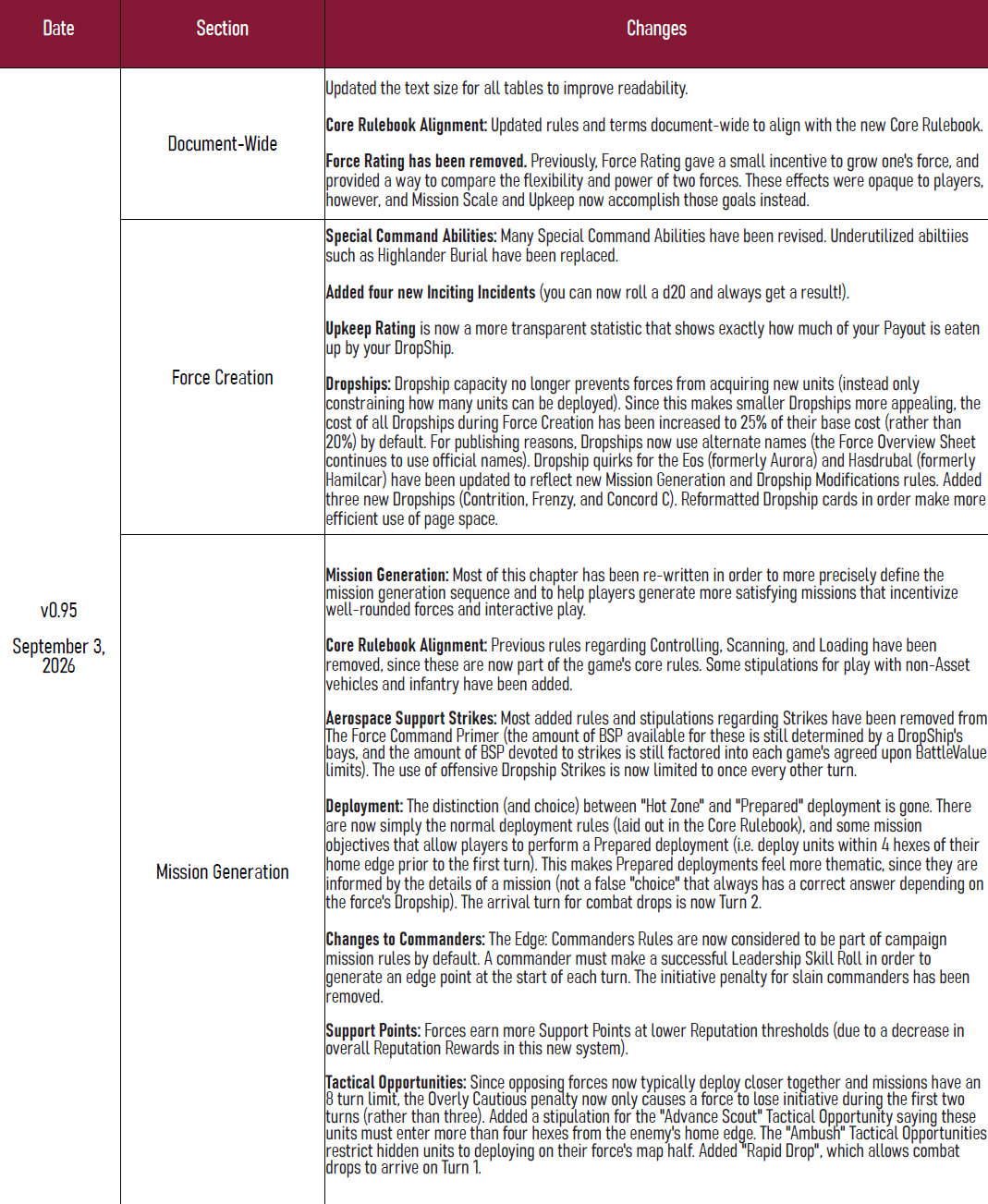
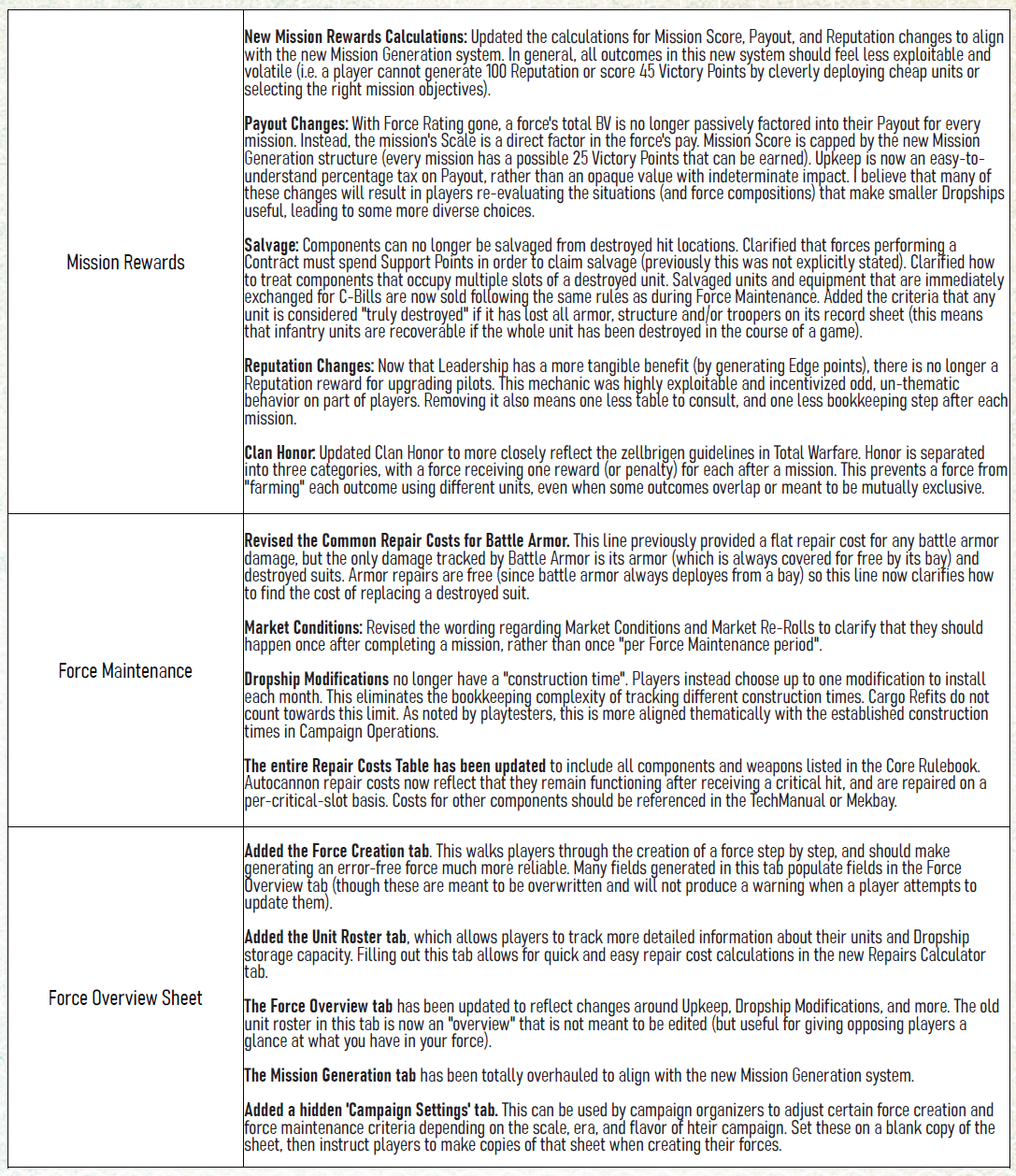
Last week, I uploaded version 0.95 of the Force Command Primer. As promised in my last blog, I took some extra time letting this cook, and did a much deeper overhaul of some systems than in previous updates. This update has also brought the Force Command Primer into the era of the Core Rulebook (which I thought would be out by now), aligning all of its language and mechanics with Battletech’s updated rules. Almost every single page has seen some refinements.
Overall, I think the system has taken a big step up in elegance and usability. A lot of impactful rules have been clarified, and a lot of unnecessary ones have been removed (version 0.95 is eight pages shorter than 0.92).
Back to Basics
The most exciting and dramatic change by far is the re-work of the Mission Generation system.
Giving players tools to construct their own missions is essential to the goal of the Force Command Primer, which is to empower players to tell their own stories without a GM. Missions are the structure for the most pivotal moments in those stories; if they are overly complex, unbalanced, or uninteractive, everything falls flat. And while the previous Mission Generation system was good at giving players a lot of ingredients (there were over 40 objectives to choose from), it didn’t provide a recipe for how to combine them in satisfying ways.
I’m getting into fraught territory if I suggest we can define a “good” game, but I think most of us can agree on the following:
A game shouldn’t be solved before it even begins.
Players’ choices should matter.
Players should have strong incentives to interact with one another.
While it was certainly possible to achieve these under the old system, my realization over time has been that this required players to have a deep understanding of the game and/or an extended discussion before each game. The big list of a-la carte objectives incentivized players to choose things that were easy to accomplish without their opponent having the ability to stop them, leaving clever players with huge paydays that their opponents were totally powerless to stop.
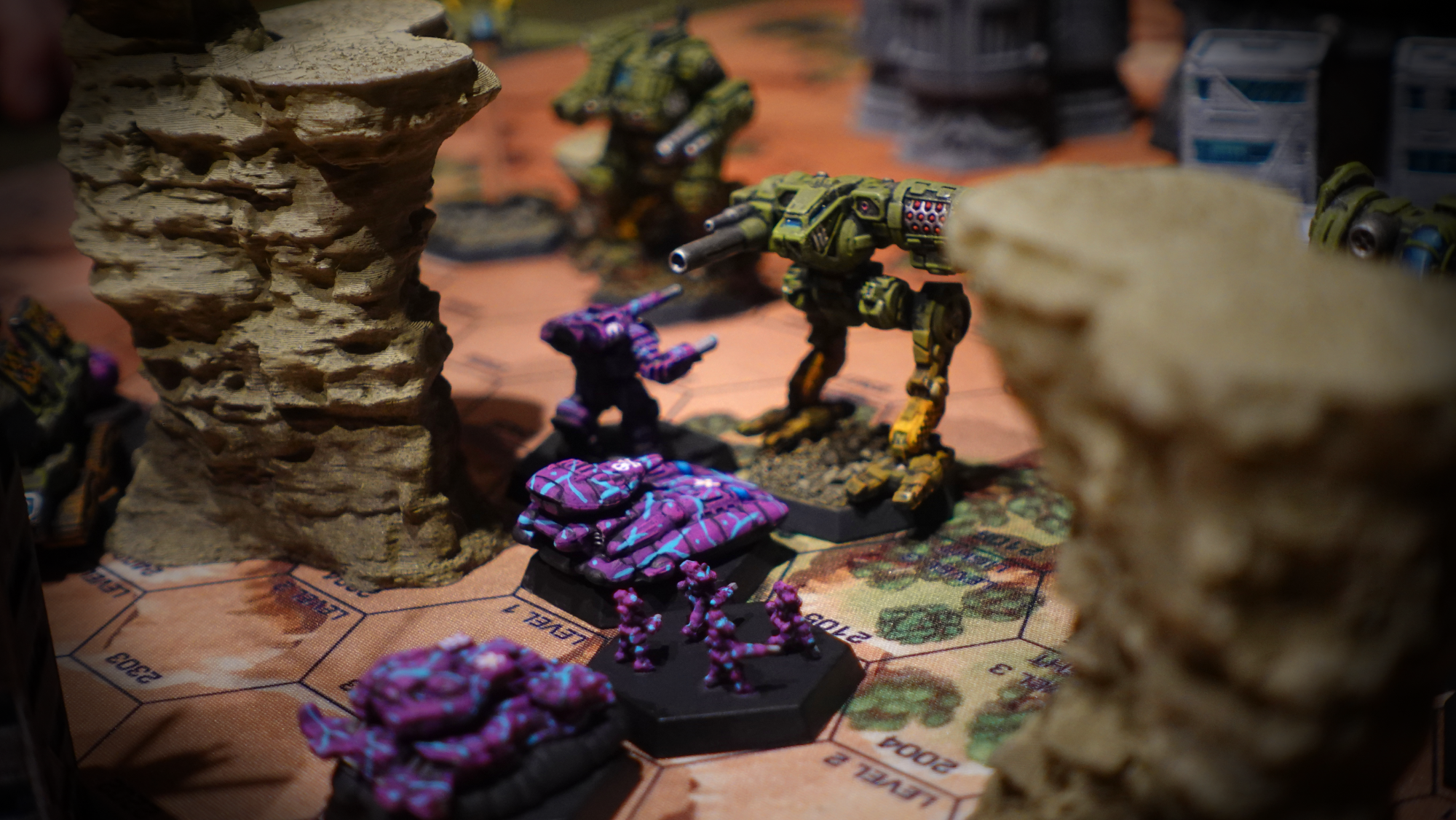
Some purdy pirates and mercenaries squabbling. Painted by some talented friends from Waystone.
Some players stop here, shrug, and say, “those people are engaging in bad faith—just don’t play with them”, but I think the problem is more complex. In a campaign system where losses have lasting consequences, the boundary between “playing well” and “being a dick” can get blurred if we both expect someone to care about preserving their force and intentionally make sub-optimal choices. A great game doesn’t say, “here are some options you’re allowed to use, but people will get angry at you for”. It gives players a range number of viable options and says, “do your very best!”
All of this in mind, I came up with these principles when I sat down to construct the new system:
Opposing forces must always interact in order to succeed (otherwise they wouldn’t end up on a battlefield together).
A player’s objectives should always be distinct from one another (clever players should not be able to earn double the points for stacking objectives with similar criteria).
All objectives should have a similar difficulty and offer similar rewards (players always work out how to eliminate the risk from “high risk, high reward” objectives).
There should be room for players to have huge successes, but a game’s outcome should never be solved in under 3 turns (and preferably not under 8).
GREAT ARTISTS STEAL
With these in mind, I started to brainstorm a broad list of objective types.
My goal here was to cover any category of objective that would be needed to construct iconic scenarios players expect to see in the Battletech universe. Inspiration here came from playtester suggestions, the Harebrained Schemes Battletech PC game, other miniatures games I see at my local club, and a tactical sci-fi game called Menace (a turn-based game where you command squads of infantry, mechs, and vehicles, then have a strategic force-management layer between games).
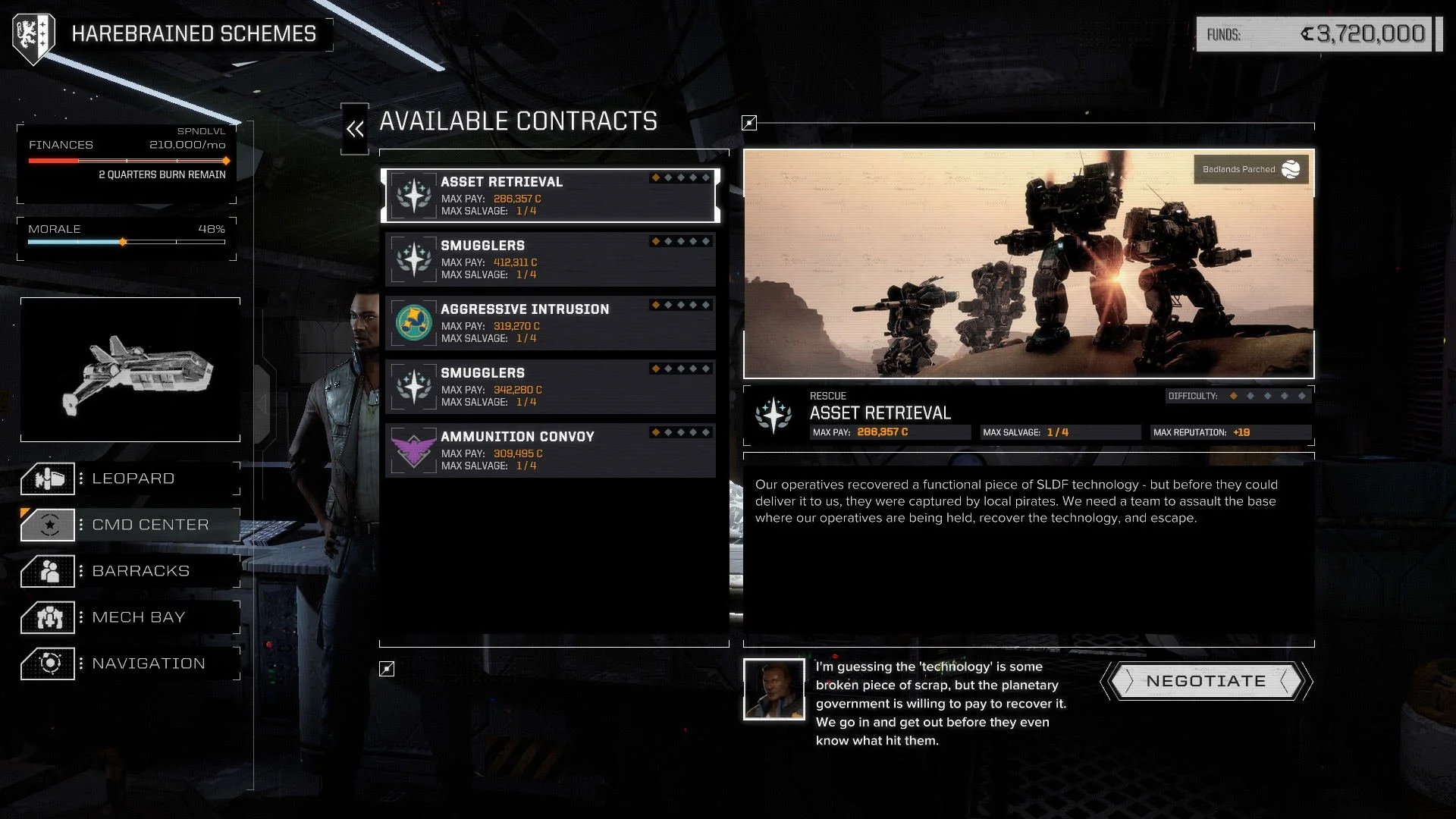
An example mission selection screen from HBS Battletech’s promotional materials.
These are the broad categories I came up with:
Attack (destroying enemy forces)
Control (holding ground)
Carry (moving, stealing, or rescuing things)
Destruction (attacking buildings and other non-personnel assets)
Move (escaping from sticky situations)
Protect (guarding and escorting civilians or other friendly units)
Scan (reconnaissance, and collecting important information)
When I talk about treating these like building blocks for iconic scenarios, here’s what I mean:
A typical Escort mission where a force is attempting to protect a convoy from assailants might be a combination of Protect (making sure the convoy doesn’t take damage) and Move (escorting it off the map). A base siege battle might involve Destruction (attackers sieging the base) and Control (the defenders holding their ground).
INTERACTION AND COUNTER OBJECTIVES
The next challenge was to think about how to define the specific objective criteria, and how they’d come together to form a complete mission.
Let’s use our base assault example from above (this sort of mission is my “white whale”, since it’s heinously hard to balance, and one of the worst offenders when it came to objectives that were exploitable in the old mission system).
A huge limitation had been that if players wanted to simulate a base defense mission where the attacker must destroy buildings in order to score, and the defender must hold the ground near the buildings, neither actually had a reason to stop one another (both could complete their unique objective without coming into contact). Players often ignored this since playing that way was boring, but the mechanical reward structure of the campaign asked, “would you prefer to take less damage and earn less money by confronting your opponent, or earn better rewards and a smaller repair bill by avoiding them?”
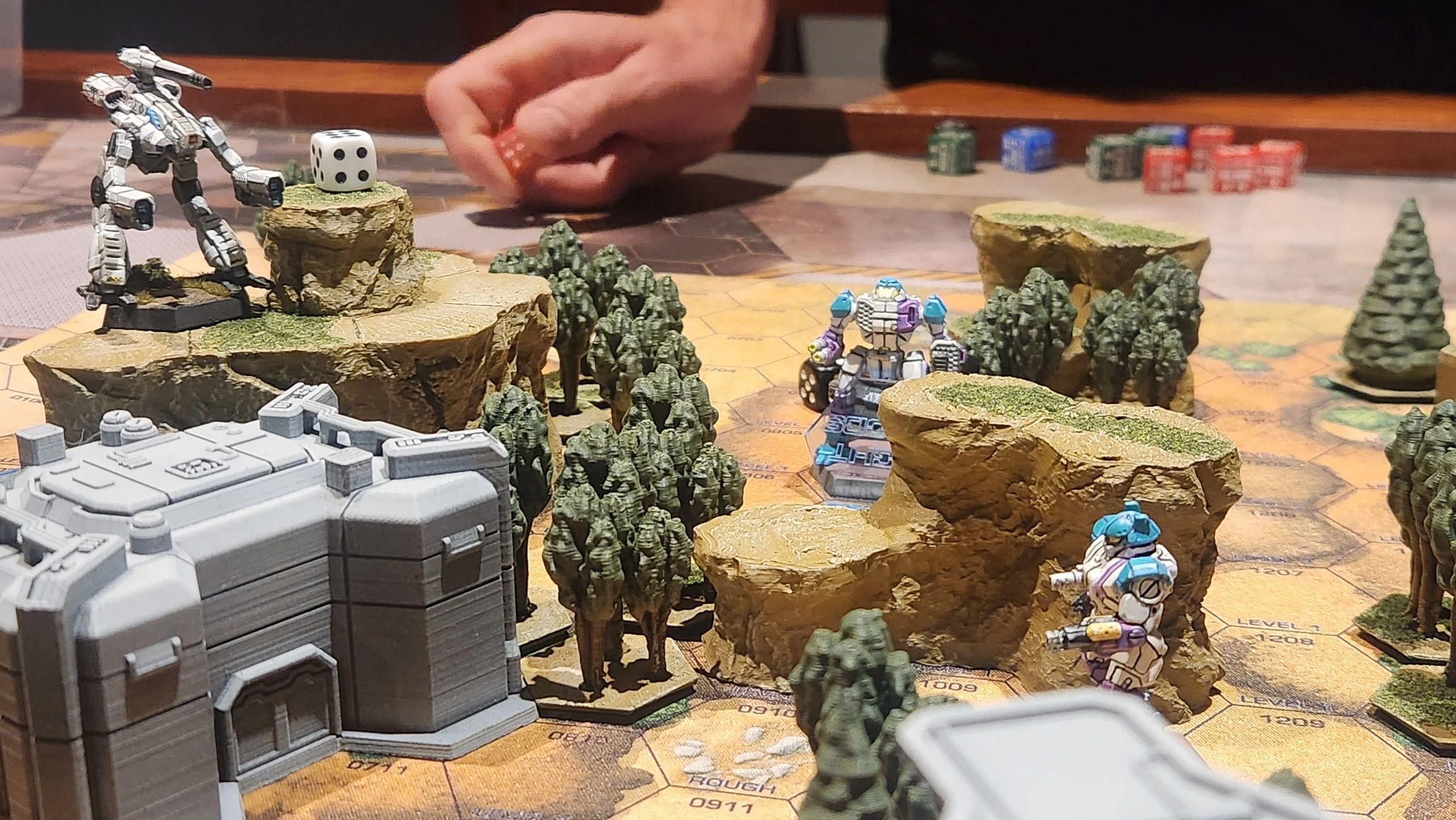
My Marauder 5CS squares off against a friend’s home brew mercenary company, Stuart’s Bucellarrii
The piece that was missing from the old system was an incentive for each force to stop the enemy in addition to pursuing their own goals. The key here was came from some playtesters in Minnesota, who shared in the Force Command Primer Discord that they always require players to select the “Stop Them Cold” objective. This objective was unique in that it was dynamic, and rewarded players for stopping the other force from completing one of their objectives (rather than defining a specific action for the force to complete).
Applied to our theoretical base assault mission, rewarding the attacker and defender for stopping one another takes things in the right direction, but even if the defenders are rewarded for stopping the attackers from destroying the base, doing so likely involves pushing their units out of the base, off of the objectives they’re attempting to hold, and into harm’s way—likely not worth the bonus pay from a secondary objective.
The only way to really put the fire under both players to interact when objectives are chosen by each player is to make stopping the enemy as important as completing the force’s own primary. If taking ground from the defenders is as important to the attackers as destroying the buildings, then suddenly the attacker has a strong incentive to advance on the base, contest the ground that the defender wants to hold, and get into a tussle. Determining the fate of this base becomes much more uncertain, tense, and messy (exactly what we want).
In the end, I landed on this structure:
Each player has one primary objective. This is the goal they must accomplish in order to pay the bills and make a name for their force.
Each player has one secondary objective that is truly a “bonus” objective. It counts half as much towards a mission’s score, but it can be completed to advance skill progression.
Each player has a “counter” objective: Prevent your opponent from scoring their primary. It has the same weight as a primary objective, meaning letting your opponent run rampant is .
SECONDARY OBJECTIVES
What about secondary objectives? If players get to choose their own secondaries, and these can be uncontested and/or ignored without penalty, we find ourselves with a smaller version of the same issue—players are rewarded for choosing whatever objective allows them to earn extra pay without engaging the opposing force or needing to make sacrifices.
Thinking about the Battletech and Menace PC games was particularly helpful here. Both of those games involve a huge range of procedurally generated missions, but I’ve never encountered a mission that feels like it “doesn’t work,”—the two opposing sides always have a strong reason interact. How could a random mission generator like this always ensure there’s not a dud?
It’s very simple: Regardless of how creative the player’s objectives might be, the computer’s objective is always the same—murder.
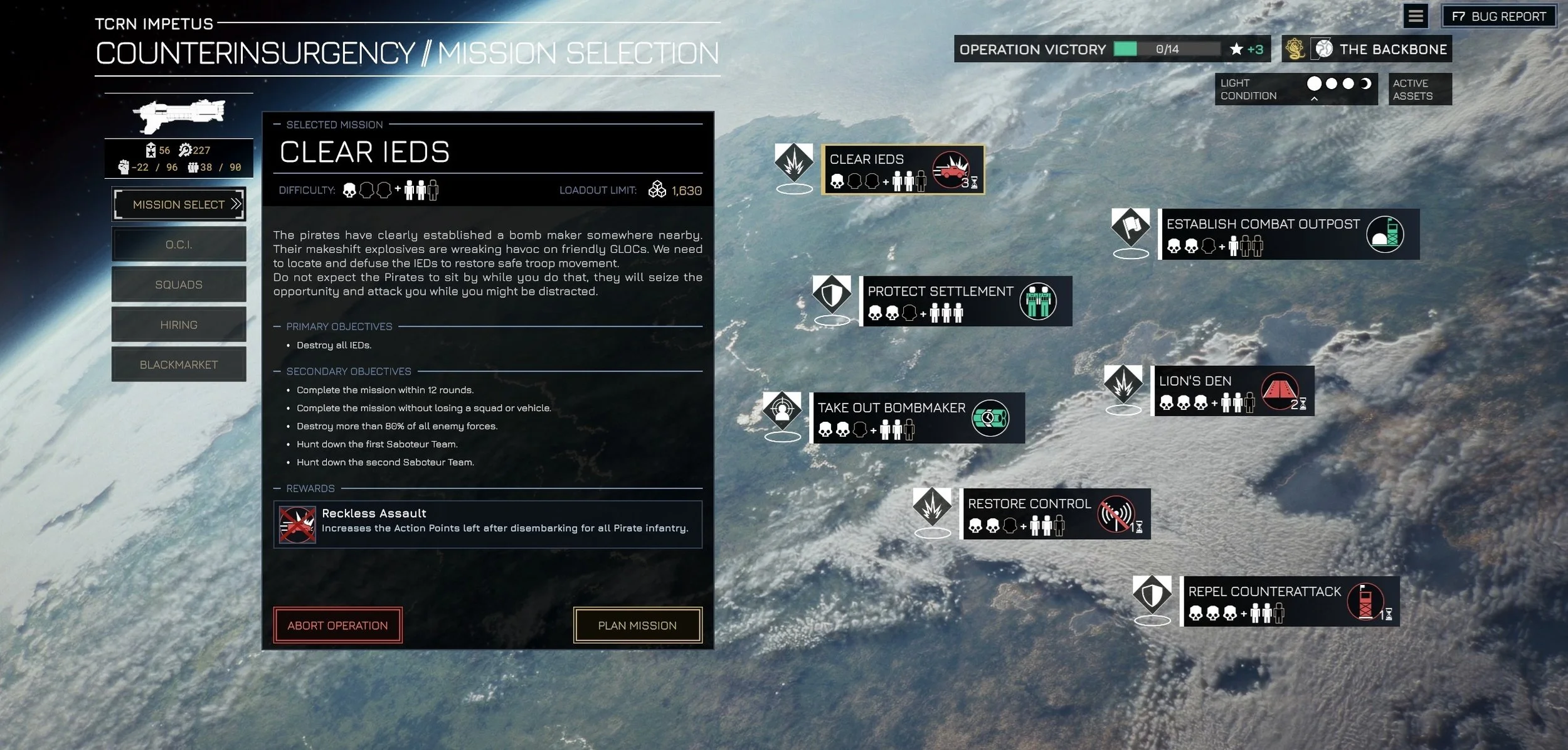
A mission selection screen from the Menace PC game, illustrating an array of the different objective and mission types.
This illuminates how Attack objectives work as quintessential secondary objectives, because they are always interactive, and can be layered onto any other set of objectives without encouraging players to avoid each other.
That being said, it wouldn’t be very fun if both players were always told to take a “kill” objective as their secondary. An enjoyable layer of campaign play is that it creates room for players to think about the long-term consequences of each engagement, and to specialize their forces. The important thing is not to always force players to form a mosh pit of Mechs, but to get them thinking hard about when and where it is rewarding to engage.
My ultimate takeaway was that some objectives are going to be more flexible when it comes to incentivizing player interaction, and some tend to encourage “parallel play” without the right guidelines. I brainstormed a big list of specific objectives for each category, and these ones stood out as good potential secondaries:
Strike, the quintessential “cripple or destroy enemy units” objective.
Discourage Pursuit, another “violence” objective oriented around targeting your opponent’s fastest units.
Identify, an objective based on scanning enemy units (you have to get into very deadly ranges to do so, unless you’re equipped with an active probe).
Escape, an objective about moving as much of your force’s BV as possible to the opposing board edge. (This was an extremely problematic objective before the introduction of counter-objectives, but a genuine dilemma when you are penalized for running off the board prematurely and letting your opponent score).
BASE ASSAULT!
With some new objective categories and distinctions, I had a skeleton for the new objective system. Here’s how our base assault mission might look:
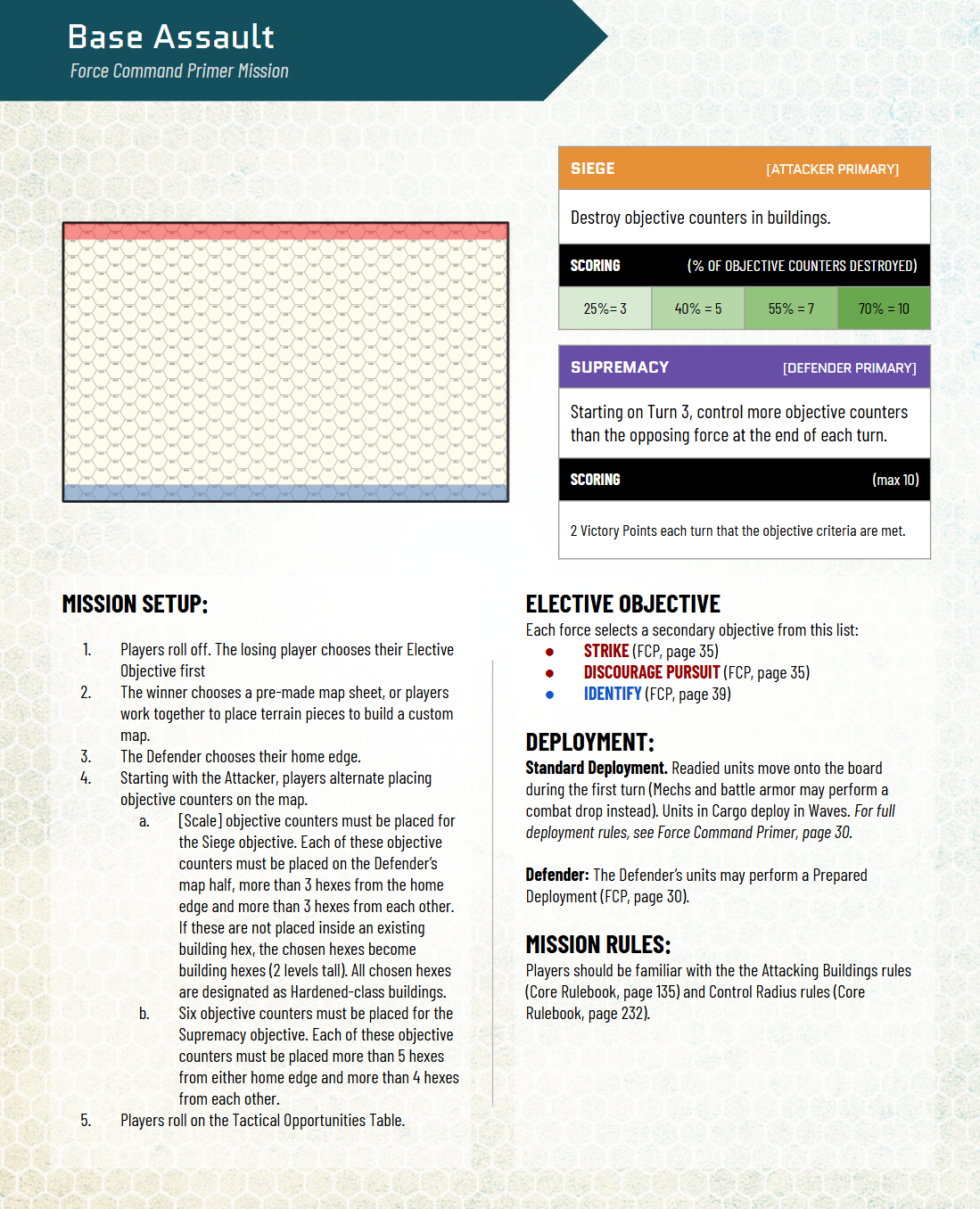
An example pre-generated Base Assault mission using the new Mission Generation rules.
Looking at this example of a “pre-generated” version of our Base Assault mission, you’ll notice a few things that were desperately needed in the old system.
First, each objective is scored progressively, so you don’t just “pass” or “fail”—there’s almost always a reason to keep scoring throughout a game.
There is also clear guidance about deployment and map setup. Previously, players needed to negotiate how the map should look, where trees should go, where important objectives should be placed, etc. 90% of the time, I think players just tried to remain impartial and trusted their opponent, but this still lead to situations where more assertive or savvy players could give themselves an advantage—particularly when one force’s objectives or special abilities hinged on the setup of the map.
Even when a mission isn’t pre-generated like above, the Mission Generation chapter (and all 14 of the new objectives) has clear instructions about how the game should be set up, how to scale things with game size, how forces might deploy differently, etc.
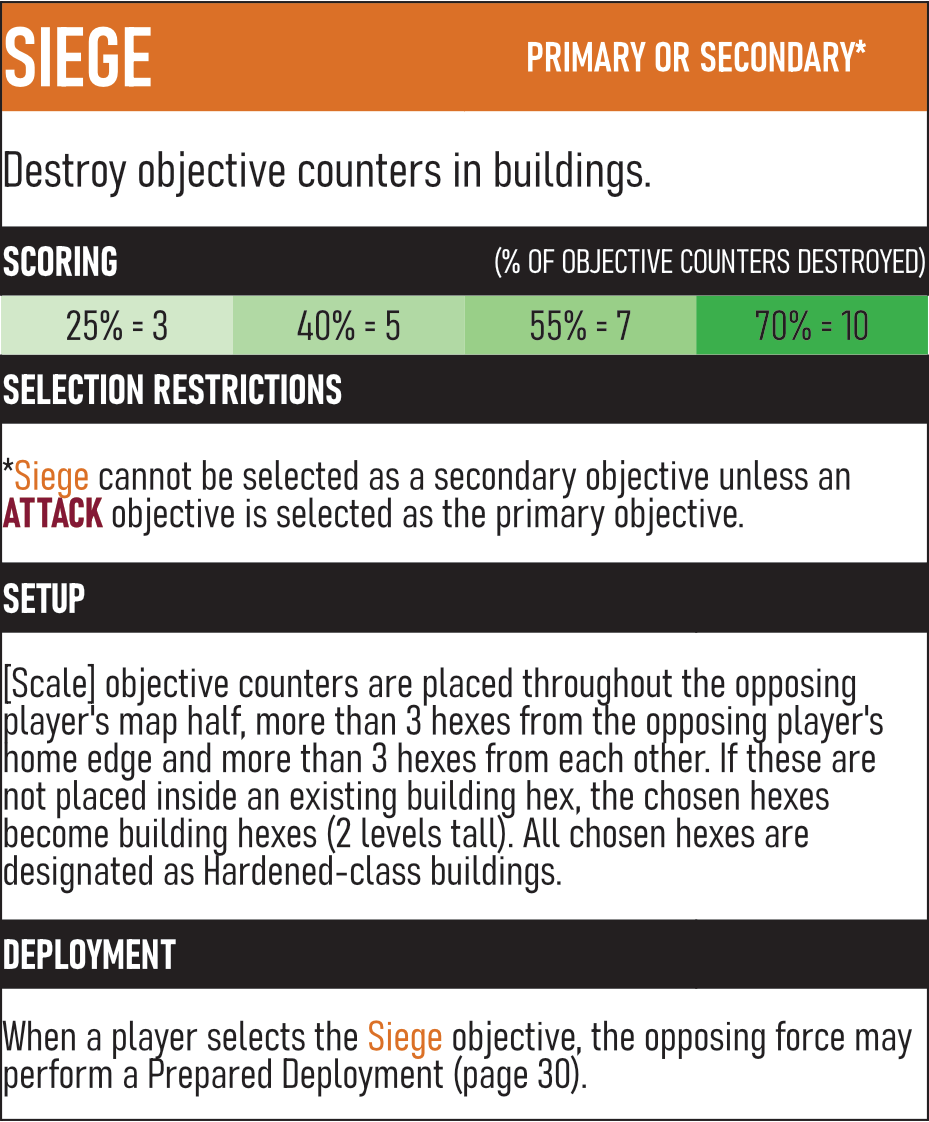
An example mission objective from the new system. There are fewer objectives, but they’re more detailed.
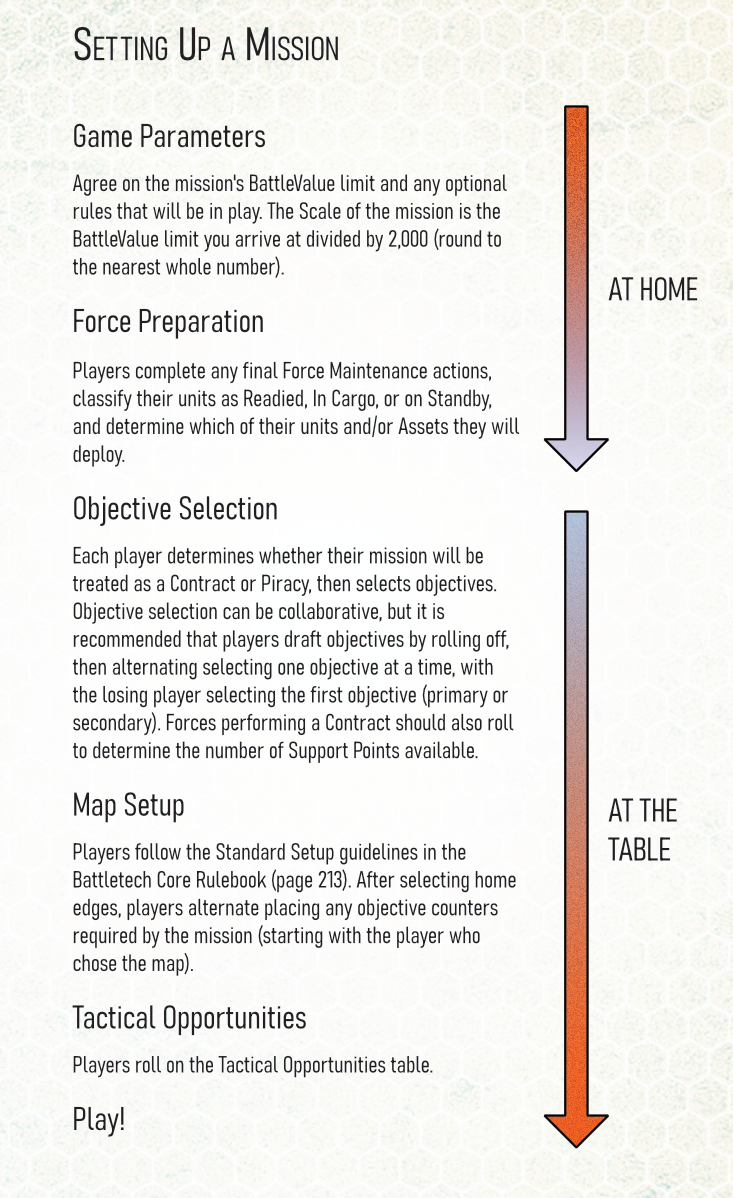
A flow chart that guides players on creating their own custom missions.
My hunch is that even though this process is more involved than before, once players go through it a couple times, they’ll realize it saves time on negotiating setup ambiguities.
Eagle-eyed players will also notice that Prepared deployment is no longer chosen by each player before the mission. Instead, whether or not forces are able to “Prepare” (deploying all of their units in forward positions, even if they are in a DropShip’s cargo) is entirely dependent on their opponent’s objective selection. It was always a non-choice before (one deployment type was always better depending how your units were stored). Now, being Prepared is a slight edge that a force gets under rare circumstances, such as when they are defending a base or ambushing a force that is trying to Escape.
Check it out!
I’ve been obsessing about this update for months and could go on and on about all of the exciting changes. Now I leave it to you all to discover stuff on your own. Go download the new version of the FCP on the home page, and take a peek at the updated Special Command Abilities, new DropShips, fresh unit capacity rules, and more!
(Also, there’s a full change log posted below)
As always, thank you all for your enthusiasm and support—they are what keep me burning the midnight oil on this project.